Time management, and why half of it never works
The research on time management says something quieter than the books do: it buys calm more reliably than output, and it only holds when it covers the whole of your life rather than the working part of it.
Time management has a bad name, and it earned it. The word brings up stopwatches, five in the morning, colour-coded weeks, and systems that last until the first difficult Tuesday. Most people have tried one, and most people have watched one fall apart.
But the thing underneath the word is not a productivity hobby. You cannot manage time: it passes at the same speed whatever you do with it. What you can manage is attention — what gets it, in what order, and what is allowed to interrupt. Everything useful under the heading of time management is a way of making that decision once, in advance, instead of forty times a day while tired.
This piece is an attempt to say what is actually known about it, where the evidence is solid and where it is thin, and why a system that covers only your job tends to die — while one that covers the whole load tends to hold.
What the evidence actually says
The largest review to date pooled 158 studies and 53,957 people (1). Three findings are worth carrying away from it.
First, the link to performance is real but moderate — correlations around .25 with job performance. Useful, not transformative. Anyone promising that a planner will double your output is selling something the literature does not support.
Second, and this is the part that rarely makes the blurb: the effect on wellbeing is stronger than the effect on work. The same review found a moderate negative association with psychological distress, and the effect on life satisfaction came out 72% stronger than the effect on job satisfaction. People buy time management to get more done. What it reliably delivers is a quieter head.
Third, it is learnable. The review found that training actually helps people manage time better, and argued against treating it as a fixed personal trait. The people who are good at this were not born with a planning gene; they are running a system you can also run.
Why the head is the wrong place to keep a life
An unfinished task does not wait quietly. In a series of experiments, unfulfilled goals produced intrusive thoughts during an unrelated reading task and worse performance on an unrelated puzzle — the mind kept returning to the thing that was not done (2).
The interesting part is what removed the effect. Not finishing the task. Writing a specific plan for it — when, where, how — brought the intrusions down to the level of people who had nothing hanging over them. The goal was still unfinished. The head let go of it anyway.
That is the mechanism behind every list that ever helped anyone, and it explains why a vague list helps less: «sort out insurance» is not a plan, and the head knows it. Researchers call the general move cognitive offloading — using the world to carry what the mind would otherwise hold (3). It is ordinary and it works, with one caveat from the same review: people are not always good at judging when to offload and when to rely on themselves.
So writing things down is not bookkeeping. It is buying attention back from the part of your mind that was guarding them.
Plans fail on the estimate, not on the will
When plans collapse, the usual explanation is discipline. The evidence points somewhere less flattering and more fixable: we are bad at predicting how long our own work takes.
In the classic study, students predicted finishing a thesis in about 34 days. They took about 56. Fewer than a third finished by the date they had named — and even their deliberate worst case, 48.6 days, came in short of reality (4). Notably, their predictions for other people were less biased. We are optimistic specifically about ourselves.
Two things fix this, and both are cheap. One is to look at the last time you did something similar before naming a date; in the same research, asking people to connect the forecast to their own past removed the bias. The other is to name the when and the where. Across 94 tests, plans in the form «when X happens, I will do Y» produced a medium-to-large improvement in actually reaching the goal (5). The content of the plan barely matters. Its specificity does.
The cost of a system you have to visit
There is a second reason systems die, and it has nothing to do with motivation. In observational work on office interruptions, interrupted tasks were typically resumed the same day — after about 23 minutes, with roughly two other tasks in between (6). That number is often quoted as if it were 23 minutes of staring at a wall; it is not. But it is a fair measure of how expensive it is to put something down and come back to it.
Now apply that to your own setup. A plan in a notes app, deadlines in a calendar, money in a banking app, the shopping list in a chat with yourself, the medical stuff in a folder of photographs. Nothing there is wrong. But every check is a switch, and the switch is the tax. When checking the system costs more than doing the smallest thing in it, people stop checking — and then conclude they are disorganised.
They are not. They are paying a toll that the system itself created.
The work nobody counts
Here the picture usually narrows to work, and that is where most advice goes wrong.
Sociologists have given a name to the part that stays invisible: cognitive labour — anticipating what will be needed, finding the options, deciding, and then monitoring that it happened (7). In interviews with 35 couples, this work turned out to be taxing, largely invisible to both partners, and a frequent source of conflict. Women did more of it overall, and specifically more of the anticipating and the monitoring.
None of that appears on a task list, which is exactly the problem. «Book the dentist» is a task. Knowing that the check-up is due, that the insurance renews in March, that the child outgrew the shoes — that is the real labour, and it has no place to live. A system that holds only your job leaves the heaviest half of the load exactly where it was: in somebody's head, usually the same person's.
Money is an attention tax
One more reason the boxes cannot stay separate, and it is the sharpest piece of evidence here.
When researchers prompted people to think about a difficult financial problem, cognitive performance dropped — but only among those for whom the problem was real (8). In the field half of the same work, sugarcane farmers were tested before the harvest, when money was tight, and after it, when it was not. The same farmers scored lower before. The authors ruled out nutrition, available time and work effort as explanations.
Read that again as a statement about planning. Money trouble does not stay in the money box. It takes the attention that your plan needs in order to exist. The person who cannot keep a system together while something financial is unresolved is not weak-willed — they are running on less bandwidth, and the fix is partly upstream of planning altogether.
Why the parts have to see each other
Put those findings next to each other and a practical rule falls out. The reason to keep one connected system is not tidiness. It is that the facts you need in order to decide anything live in different boxes.
A day is one object. The meeting, the payment, the nine thousand steps, the bad night of sleep and the chore that came due all happened on the same Tuesday, to the same person, out of the same twenty-four hours. Splitting them across five apps is a filing decision, not a fact about your life.
And a priority is a comparison. You cannot rank things that live in separate lists — you can only rank them side by side. «Is this more important than that?» is unanswerable when this is in a work tracker and that is in your partner's head. Most of what people call a priority problem is really a visibility problem: everything looks urgent because nothing is next to anything else.
This is also why single numbers mislead. Steps mean one thing after seven hours of sleep and another after four. A month's spending means one thing in a month with two trips and another in a quiet one. A missed habit means one thing in an ordinary week and another in the week someone was ill. The neighbouring fact is what turns a number into information, and the neighbouring fact is in the other box.
What this does not mean is one enormous application that does everything badly. Integration is not a feature list. It is one axis — the day — that every part can answer about: what was planned, what was spent, what was measured, what arrived. Sections stay separate; the day is shared.
The same mechanism at every age
The evidence above is mostly about adults, and honesty requires saying so. But the mechanism — move it out of the head, make it specific, keep it in one place — is not age-specific, and what changes is only what it is used for.
A child is not learning to be efficient. They are learning that a thing has a sequence and an end: the external list is scaffolding for a skill that is not built yet, and it comes down as the skill grows.
A teenager needs the opposite of imposition. A system handed down is a system abandoned; the one they chose themselves, even a worse one, is the one that survives. The useful parental move is usually to make the load visible rather than to manage it.
An adult carries the widest version: paid work, the invisible household labour above, money, health, and other people's dates. This is where an unconnected setup breaks most expensively, because it is here that the boxes multiply.
Later, the point shifts again towards continuity: medications, appointments, documents, what a doctor will ask and what a family member would need to know. A record that does not depend on anybody's memory, and that can be handed over.
The smallest version that holds
If you take one thing from all of this, make it a small thing — the research is clearer about mechanisms than about any particular method.
One place, and it should be the boring one you already open for another reason. Anything with a date goes in with its date, even if the date turns out wrong. Anything under two minutes never gets written down at all, because writing it costs more than doing it. For the two or three things that actually matter this week, write the when and the where rather than the what (5).
Before you name a deadline, look at how long the same kind of thing took you last time (4). Once a week, spend ten minutes looking back rather than forward: the look-back is what keeps the estimates honest.
And give it time. In the study people usually quote for the 21-day myth, the real median was 66 days to reach the plateau, with an enormous range — 18 to 254 — depending on the habit (9). The same study found that missing a day or two did not break the trajectory. The thing that breaks it is concluding, after the missed day, that the system does not work.
What it will not do
It will not create hours. Nothing does, and any method that claims to is making a promise about arithmetic that arithmetic will not keep.
It will not fix a load that is genuinely too large. It will make the size of it visible, which is sometimes the solution and sometimes merely the bad news — but the bad news is still worth having in a form you can show to somebody else.
And a system is not a life. The point of running one is to spend less attention on administering your days and more on the things the days were for. If you find yourself maintaining the system for its own sake, it has become the thing it was supposed to remove.
Where a space helps
Everything above can be done with paper, and plenty of people do it that way for years. The one thing paper cannot do is answer about the day on its own: what was due, what was spent, what came in from your watch, what letter arrived.
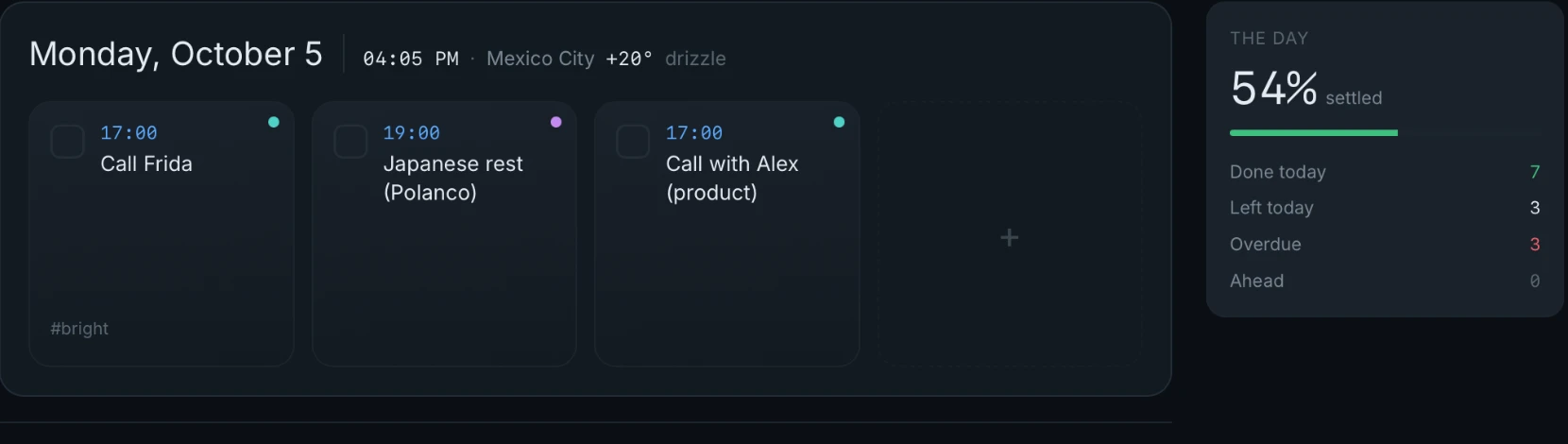
That is the whole reason this product exists, and it is the only claim worth making for it. A space here keeps the planner, the money, the notes, the documents and the health record in one place, and they share one axis — the day you are looking at. Free, no advertising, and nobody else reads it.
Sources
- 1. Aeon, B., Faber, A., Panaccio, A. (2021). Does time management work? A meta-analysis. PLOS ONE 16(1): e0245066. 158 studies, 53,957 participants. Open
- 2. Masicampo, E. J., Baumeister, R. F. (2011). Consider it done! Plan making can eliminate the cognitive effects of unfulfilled goals. Journal of Personality and Social Psychology 101(4). Open
- 3. Risko, E. F., Gilbert, S. J. (2016). Cognitive Offloading. Trends in Cognitive Sciences 20(9), 676–688. Open
- 4. Buehler, R., Griffin, D., Ross, M. (1994). Exploring the «planning fallacy». Journal of Personality and Social Psychology 67(3), 366–381. Open
- 5. Gollwitzer, P. M., Sheeran, P. (2006). Implementation intentions and goal achievement: a meta-analysis of effects and processes. 94 independent tests, d = 0.65. Open
- 6. Mark, G., on observational studies of workplace interruption: work resumed after about 23 minutes, with roughly two intervening tasks (Gallup Business Journal interview). Open
- 7. Daminger, A. (2019). The Cognitive Dimension of Household Labor. American Sociological Review 84(4), 609–633. 70 interviews, 35 couples. Open
- 8. Mani, A., Mullainathan, S., Shafir, E., Zhao, J. (2013). Poverty Impedes Cognitive Function. Science 341(6149), 976–980. Open
- 9. Lally, P., van Jaarsveld, C. H. M., Potts, H. W. W., Wardle, J. (2010). How are habits formed: Modelling habit formation in the real world. European Journal of Social Psychology 40(6). Median 66 days, range 18–254. Open